
Need Blue Art Tours Help?
Mailing List
Sign up for our mailing list to get latest updates and offers.

Join us in protecting Rwanda's MTB trails. We ride on world Nature Conservation Day celebrated every year on July 28th to raise awareness about protecting Earth's natural resources and promoting sustainable habits. Sign up for our next conservation ride and help preserve the trails you love to explore.
Environment Conservation Guardian Ride — July 28th, 2027. Be part of history from day one.
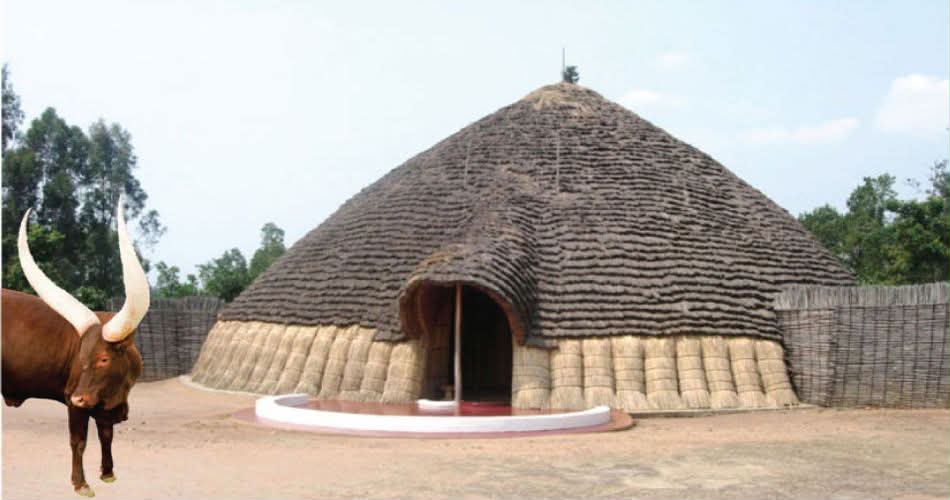
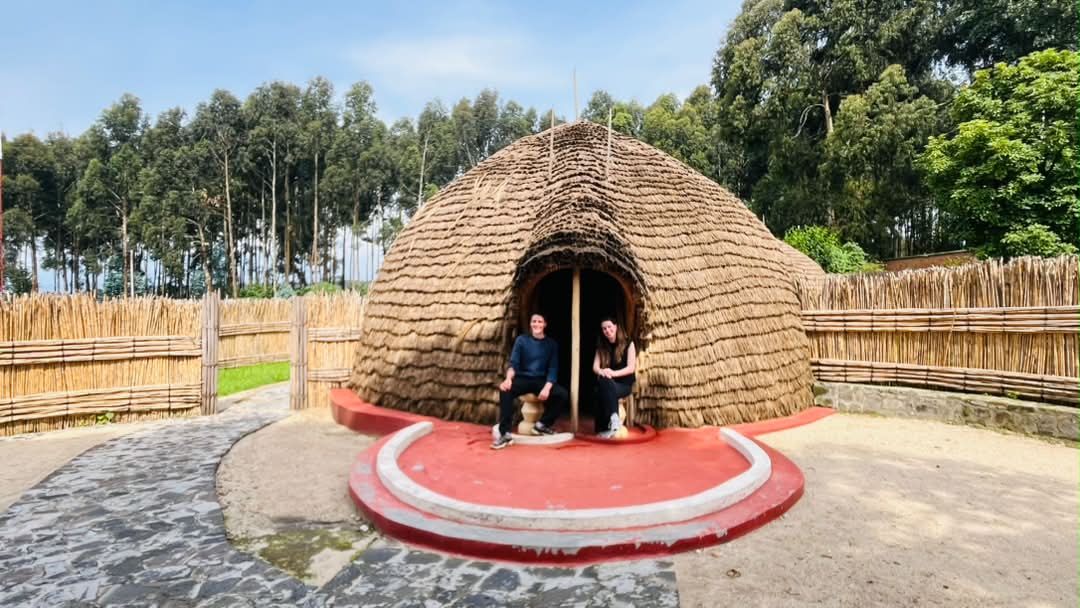
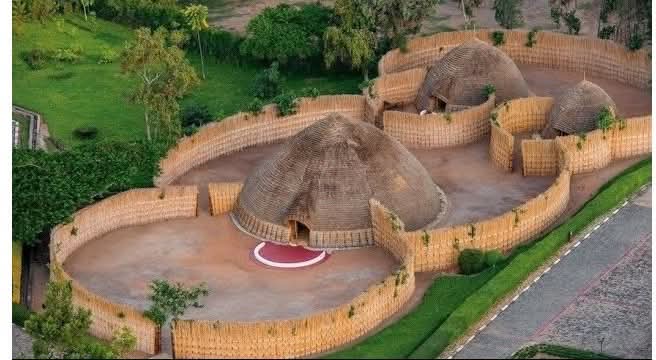
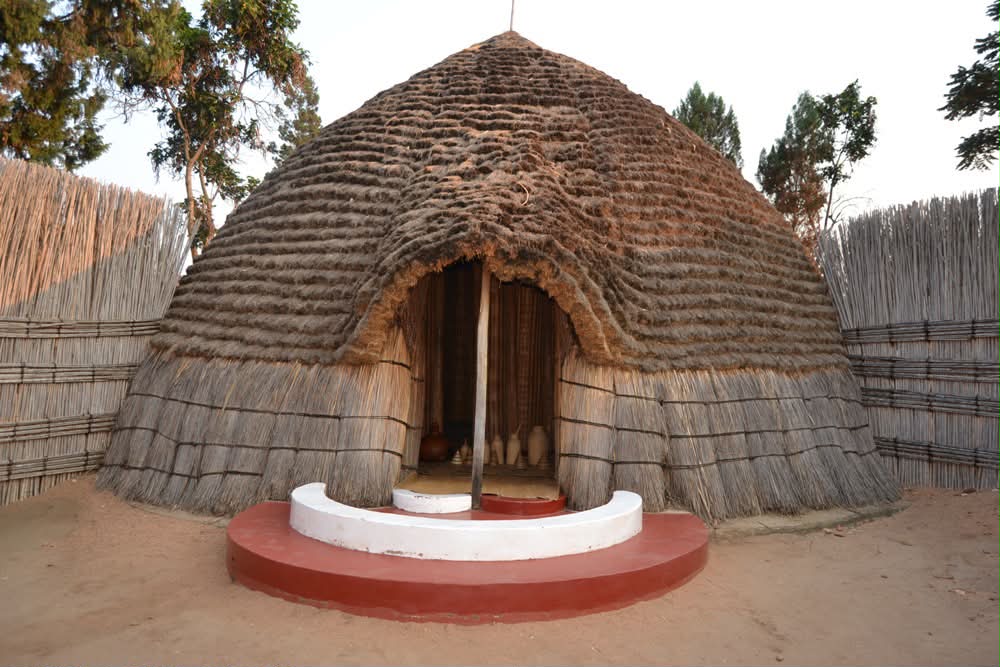
The circular beehive-type dwelling called a rugo was the standard home in pre-colonial Rwanda. It stood at the center of a courtyard surrounded by bamboo and thorn hedges, built on a circle of closely spaced cypress poles with their tapering tops bent down to the center and tied with concentric rings of reed and bamboo. The exterior was thatched with overlapping bunches of grass tied to the frame rings.
Every hut had only one entrance. A woven porch protected the entrance, making a structure that was highly insulated and well-adapted to the high temperatures and humidity of the Rwandan highlands. Cooking, latrines, and stores were located in the surrounding courtyard.
Inside, the nyakatsi hut was spacious, often had a central pole supporting the roof, and the space was divided using reed mats to create separate "rooms."
The skeleton of the hut was covered with marsh grass, cypress, or sorghum stems, and the soil floor was treated and covered with a layer of fine grass, on which small mats were spread. The ceiling the most important architectural element was prepared independently and placed in the middle of the poles, maintained at the right height by about fifteen to twenty pillars.
The royal compound was a world apart from common homes. The royal compound (rugo) was made of a circular reed fence around thatched houses. The houses were carpeted with mats and had a clay hearth in the center for the king, his wife, and his entourage. The royal compound was enormous close to 200 yards and looked like a huge maze of connected huts and granaries, with one entrance leading to a large public square called the karubanda.
The King's Palace in Nyanza is the iconic example of pre-colonial Rwandan architecture circular with a large thatched roof supported by wooden pillars. Its construction was an elaborate process involving skilled craftsmen, reflecting the power and wealth of the monarch. The architecture emphasized symmetry, circular forms, and hierarchy in spatial organization.
It was constructed using indigenous materials such as wood, grass, and cow dung authentic to Rwandan royal buildings with an imposing thatched roof that conveyed grandeur through sheer scale.
When you step inside, the air is noticeably cool, due to the thick layers of grass that provide natural insulation. The interior is divided into different sections: the King's private quarters, a place for his advisors, and a dedicated area for the royal milkmaid.
Within the royal compound there were various huts, each serving a specific purpose: the king's sleeping hut, the Queen Mother's hut, the traditional kitchen, and huts for brewing traditional beer.
One of the most curious details: the royal beer brewer's hut had an entrance without a lip an architectural oddity with specific ritual meaning.
In ancient Rwandan culture, milk was a sacred symbol of wealth and status. The palace had a special hut where the royal milk was handled and kept pure. The woman who looked after the king's milk was dedicated entirely to this sacred role and was never able to marry. She was, in effect, a keeper of one of the kingdom's most sacred substances.
Trees were not merely plants in ancient Rwanda they were living symbols of power, protection, and justice.
Umuko — known for protection, umuko was planted at the entrances of royal spaces and graves, paralleling the role modern Christian traditions give to crosses. This tree featured prominently in rituals to ward off evil and was associated with the founder of the Kubandwa religious tradition. Umuko and Umurama were integral to royal rituals aimed at reinforcing kingship and national identity, with rituals invoking blessings and divine protection.
Umuvumu (a sacred Ficus tree) — this was the tree of governance and justice. Members of the king's advisory council, clan elders, and royal sorcerers passed important resolutions under its shade. Trials were also held under the canopy of its branches. Its role even extended into modern times: Gacaca court trials were conducted under imivumu in different parts of the country after the atrocities of 1994, to speed up the overwhelming number of genocide cases.
In pre-colonial Rwanda, traditional rituals were conducted in shrine-like settings sheltered by imivumu, administered to ward off bad luck and seek ancestral intervention in times of war, famine, and epidemics. From umuvumu, construction materials, herbal remedies, and clothing fabrics were also processed. Although in most cases, it was an abomination to cut it down.
An ancient ficus tree was considered sacred in Rwandan culture and marked the place of the king's court in ancient times. Finding a ficus tree of significant age in the countryside was essentially a historical landmark a sign that a king's court once stood there.
The palace was a place of elaborate protocol:
Perhaps the most iconic feature of the ancient court was its cattle. The word Inyambo refers to a special category of long-horned cattle associated with prestige and honour within the royal court, belonging to the broader Ankole cattle family of the Great Lakes region.
These famous "Royal Cows" are easily recognizable by their incredibly long, thick, white horns that curve gracefully upward like giant crescents. In the past, they were not used for meat or milk in the ordinary way, they were treated like royalty themselves.
Shepherds croon love songs to the animals to keep them peaceful and obedient. Each cow has a name and is tended to like a member of the family. They are trained to listen to their shepherds' songs as a means of following commands.
These cows were never slaughtered because they were considered sacred. They would be paraded during the annual National Harvest Day, thousands of them passing in front of the king, an activity that could last for several hours. The cows raised dust that hung over the kingdom for hours, a sign that the monarchy was healthy.
Their trainers kept alive historic traditions, decorating them with jewelry and training them to listen to songs and poetry, taking part in stately parades during royal ceremonies. Archaeology Travel
The cultural reverence for cattle ran so deep that to this day, if a man wants to compliment a woman, he tells her she has a calf's eyes. And asking a shepherd how many cows he owns is considered akin to asking how rich he is.
Igisoro is one of Rwanda's oldest traditional games, a game played by kings with their friends, but also by children, youth, and adults across the country. It is made from wood in the form of a small table with 32 pits and 64 seeds, played by 2 people. Each player has 2 rows of 16 pits with 32 seeds. To start, one row of 8 pits holds 32 seeds with 4 seeds in each pit.
The game rewards deep strategic thinking, players must pay close attention, calculate, and decide precisely where to move. It is the mancala of Rwanda, related to Omweso in Uganda, and remains a living heritage game.
Rwandan traditional marriage was a multi-stage, community affair:
Kuranga the bachelor's family chose a umuranga (liaison) to investigate and "hook up" the match, researching the prospective bride's ancestry and social standing.
Gufata irembo literally "taking the gate." The bachelor's father or a special family representative visited the girl's father to declare the son's intention to marry. If accepted, arrangements were made for the introduction ceremony.
Gusaba the introduction ceremony where the umuranga officially requests the girl as a bride. The process involves a fascinating battle of wits, with riddles, tongue twisters, and pranks from the girl's family side. The local community was invited because the bride's welfare was their collective responsibility.
Gukwa payment of the bride price (dowry), negotiated between the families.
The bridal preparation before the wedding, the bride spent several weeks secluded under the care of her aunt, who advised her on home and family care. The bride went through intensive beauty treatment daily application of perfumed cow-ghee and special herbs gave her softer, smoother skin. She also adhered to a strict diet, resulting in a glowing bride on the wedding day.
The Ingobyi on the wedding day, the bride did not walk. She was carried in a traditional carrier known as the Ingobyi, which had two handles.
After the wedding, a new hut was constructed for the bride within the husband's compound, furnished with sleeping mats, cooking pots, and utensils. Songs, dances, and communal participation ensured public recognition of the marriage and the integration of the bride into the clan.
The origins of imigongo art are royal. It began in the 18th century in the Gisaka kingdom (now Eastern Province), with Prince Kakira credited with its invention he wanted to decorate the inside of his hut. The art became popular with the Rwandan monarchy and was used to decorate royal homes. It uses cow dung mixed with natural pigments black from banana skins and aloe, white from kaolin clay, and red from local soil forming bold geometric patterns that carry symbolic meanings about protection, lineage, and reconciliation.
Buhanga means "Creation" in Kinyarwanda. Rwanda's first King, Gihanga (meaning "creator"), had his kingdom at this forest site, and all subsequent kings performed rituals here before ascending the throne with the exception of the last king dethroned in 1959.
A natural spring called Gihanda, named after King Gihanga, was integral to coronation rituals. Kings would bathe in its waters as part of a ceremonial cleansing before being anointed and crowned. The lava rock platform where they received the instruments of royal power still stands today. IGIHE
Ancient Rwanda was a deeply organized, symbolically rich kingdom where huts, trees, cattle, games, and ceremonies all carried meaning that wove together governance, spirituality, beauty, and social order into a single, remarkable way of life.
© 2026 Blue Art Tours. All rights reserved
Blue Art Tours
